
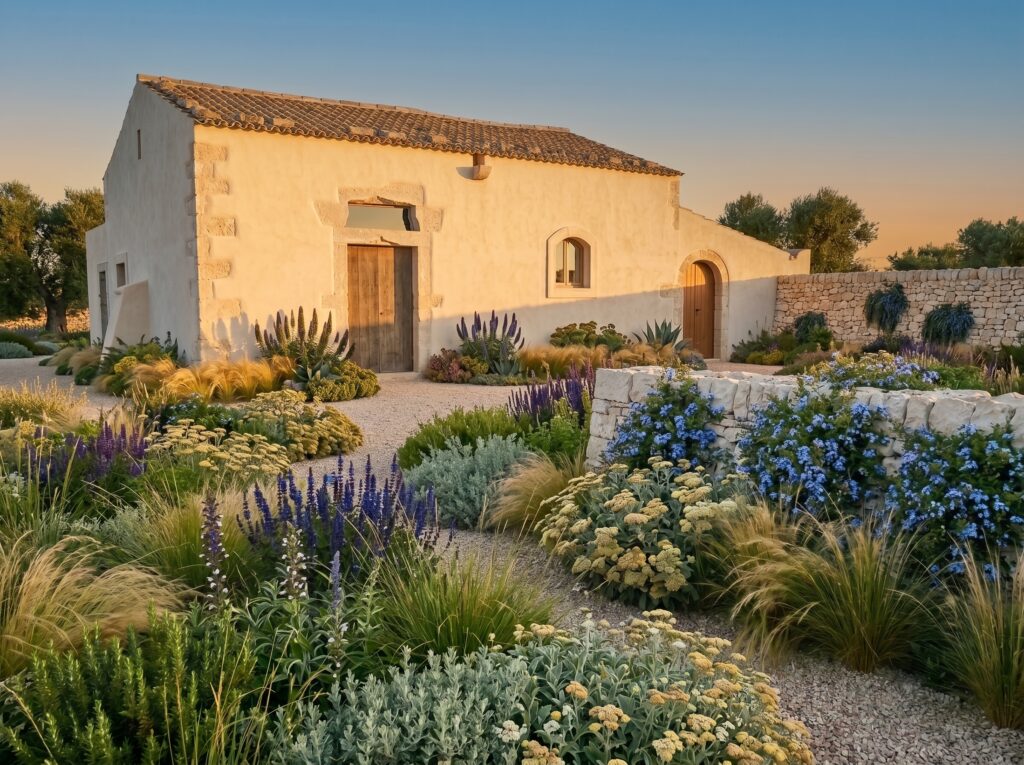
Designing luxury gardens and outdoor spaces for masserie
Beyond olive trees and stone: contemporary cardens in ancient Apulian masserie
Designing the exterior of a masseria in Puglia never means imposing a preconceived or forced vision. Above all, it means listening carefully and silently to the surrounding landscape, to truly understand the nature and the rural environment.

Crossing the monumental threshold of these ancient dwellings, you are immediately enveloped by a blinding light and the sharp contrast between the white lime of the walls and the deep red of the earth. For countless decades, these imposing stone structures have been the crucial hub of an extremely hard and essential agricultural life, historically conceived as self-sufficient and fortified microcosms to defend against external incursions. Today, the process of transforming these vast spaces into places of peace and contemplation requires immense respect for the historical and cultural stratification of the site. Our approach is based on a deep understanding of the local ecosystem, seeking an authentic elegance that shuns any ostentation. Accepting imperfection and respecting natural cycles become the true, invaluable added value of contemporary design.


Historical roots: the hortus conclusus and the wisdom of dry stone walls
To conceive a green space that is historically and botanically credible, we must inevitably look to the past. The historical green core of the traditional Apulian masseria was almost never an ornamental garden in a purely scenographic sense, but rather a true walled garden, a concept derived from the ancient monastic tradition. These imposing perimeter walls, expertly built in bare dry stone, served to create an essential protected microclimate, shielding the most delicate crops from the salty winds coming from the coasts. Today, the design challenge is to preserve the soul of the place.

Tradition is maintained by reintroducing precious citrus trees, elements that have always been inseparable from the local farming culture, combining them with the soft blooms of perennial species.

Dry stone walls play a crucial role in this transition. Originally built not only from the need to clear stones from the fields, but also to stem soil erosion and mark property boundaries, today they have lost their primary vital function to take on a strongly aesthetic and narrative value. They are no longer experienced as rigid barriers, but gently separate and connect the property to the vast surrounding rural landscape. They thus become an extraordinary architectural and communicative element, which we reinterpret and enhance with plants. By skillfully mixing shrubs, ornamental grasses, and perennials, we manage to soften them, highlighting and enhancing the bare stone within the new landscape.

The great turf deception
If there is one element capable of destroying the authenticity of an Apulian masseria, it is the endless, fluorescent green expanse of a lawn in a full Mediterranean climate. Often, this solution is a cultural legacy typical of cool, rainy countries that do not belong to these latitudes. Science guides us today towards more logical and up-to-date conclusions. If an arborist is asked to top a tree, they will explain that such an illogical practice is destructive to the plant’s health.

Similarly, we advise against laying out huge, highly water-consuming lawns. A cool-season grass lawn in Puglia requires daily watering because it suffers from heat stress in the summer and becomes susceptible to fungal diseases. We need to change our perspective, starting with a strategic reduction of the lawn, limiting it only to areas where it is actually lived on and functional. Secondly, the choice of species is fundamental. In hot climates, we always prefer warm-season grasses. Unlike cool-season grasses, these are in full vegetative growth during the summer, benefit from high temperatures, and require less water, resulting in a much healthier lawn. But we can go further, exploring true alternatives to grass. We are talking about broadleaf creeping herbaceous plants, which are widely available today. By using groundcover species like Phyla nodiflora, Verbena x hybrida ‘Prostrata’, or Achillea crithmifolia, we create alternative flowering lawns that are extremely easy to manage. These solutions require little water, offer blooms for many months, and exponentially increase biodiversity. In doing so, we create a context that is better integrated with the surrounding natural landscape, abandoning artificial whims to embrace a much more coherent and sustainable beauty.

The Xylella experience
The need to find an alternative to lawns becomes urgent when observing a very common mistake: the absurdity of combining centuries-old olive trees with a lawn at all costs. Often, these monumental plants are kept to highlight a connection with the rural landscape, yet surrounding them with grass is entirely wrong from every point of view. The olive tree is a tenacious plant, evolved to withstand scorching summers thanks to its ability to efficiently store resources and enter vegetative dormancy. A cool-season lawn, on the contrary, demands constantly moist topsoil. The constant humidity during the summer period, along with the loss of biodiversity that a lawn can entail, creates particularly adverse conditions for the natural biological cycle of the olive tree. When designing a garden in an extraordinary context like Puglia, one cannot give in to visual stereotypes; coherent landscapes must be created. A vegetated, walkable surface that aligns with the real water needs of an olive tree is undoubtedly composed of flowering groundcovers, rather than thirsty cool-season grasses. In this way, we create a system with convergent, not diametrically opposed, summer water requirements. The case of Xylella, which represents an existential problem for the Apulian landscape, teaches us exactly this. It shows us how a profound alteration of the environment, often caused by constant tillage and intensive agriculture, makes the entire ecosystem dramatically fragile. In a garden, which must be a functional and livable space, we can act without further forcing a nature already heavily stressed by humans. With current ecological knowledge, we strive to respect the environment through the correct use of plants, limiting lawns and replacing them with ecological alternatives. These solutions easily integrate into the Mediterranean climate, restoring maximum sustainability to the site.

The invisible geological secret buried beneath the fertile red earth
A frequent design mistake in understanding gardens in Puglia (and beyond) is ignoring the vital biology of the soil. The typical red Apulian earth, resting on the various karstic and calcareous formations that cross the region, is rich in minerals but often poor in organic matter due to intensive agriculture and the arid climate. Fortunately, the underlying bedrock is crisscrossed by natural fractures and deep karstic cavities. These openings guarantee excellent drainage of winter rainwater. To improve the physical structure of the soil, deep tilling is almost always necessary. Even though Apulian soil is inherently very suitable for Mediterranean and drought-resistant plants, scarification increases the oxygen supply and lays the foundation for a substrate full of life. To make it so, we apply regenerative agriculture techniques, which are now an integral part of our processes. Through the targeted inoculation of microorganisms, such as bacteria and mycorrhizal fungi, we restore the complex life in the soil. These symbioses allow plants to absorb otherwise inaccessible nutrients, improving resistance to environmental stress. The addition of crushed stone on the surface, acting as an inorganic mulch, ensures perfect drainage and, combined with infrequent but abundant watering, encourages the vertical development of root systems. Supported by microorganisms, the roots manage to explore the soil effectively, ensuring lush growth without being forced. In this way, we make the plants resilient and drought-resistant even during the hottest summers, while simultaneously restoring fertility and protection to the soil. Together, we thus create stable ecosystems that require fewer resources and enhance the authentic beauty of the rural Apulian landscape.

The heart of the garden and the identity of the Mediterranean scrub
To conclude the discussion on olive trees, it is essential to clarify that these trees should always be placed in planted areas. The concept of a centuries-old olive grove surrounded by a lawn, which we unfortunately often see in some projects, goes against any concept of sustainability and, above all, common sense. Olive trees should be placed within communities of cultivated plants, surrounded by shrubby vegetation, because only then will they find the same water requirements as the neighboring species. So let’s remove the olive tree from walkable surfaces, place it in coherent contexts, and arrive at the beating heart of the garden. Given the favorable pedoclimatic conditions for Mediterranean plants, we therefore create a strong underlying structure using typical maquis shrubs, such as Pistacia lentiscus, Phillyrea angustifolia, or Juniperus oxycedrus. But we don’t stop there. Our goal is to recreate real ecosystems using subshrubs and herbaceous plants typical of Apulian grasslands and garrigues. This approach refers to the contemporary concept of the naturalistic garden, a movement that started in Northern Europe but which we perfectly merge with the Mediterranean climate.

By wisely using plants no longer as isolated elements but as interconnected communities, we make garden management decidedly more reduced and sustainable over the years. By doing so, we envelop these ancient architectures in a living, contemporary ecosystem that is deeply respectful of the environment. In addition to bestowing authenticity, elegance, and perfect harmony, the garden conceived in this way moves towards a perfect and autonomous biological balance. Indeed, our gardens require a reasonably reduced amount of water, indulging the nature of the place without ever forcing it. It is precisely this drastic reduction in water demand that allows us to tackle with extreme lucidity and awareness the central and vital theme we will cover in the next step, namely the intelligent management of water resources.

Invisible engineering: water management and mineral mulching
Tackling the issue of water in a luxury garden in Puglia requires a radical paradigm shift, permanently distancing ourselves from old habits. Let’s forget daily and superficial watering. Our approach to water management is based on invisible but effective engineering, which starts right from soil preparation. We use a very thick initial layer of local limestone gravel as a mineral mulch. This thick blanket of gravel is the true, invaluable technical secret: it protects the earth from the scorching summer sun, almost completely eliminates harmful surface evaporation, and keeps the root systems incredibly cool. The technical effectiveness of this layer is so high that, in a Mediterranean context, it theoretically allows us to create complex naturalistic gardens even without an irrigation system, relying on the competence of those who care for them. However, even when we install automatic drip line systems, our final and absolute goal remains the self-sufficiency of the planted species. Water should never be administered in small daily doses, but used abundantly and infrequently, exactly simulating natural rainfall. Mediterranean plants drink in nature during the autumn and spring. If the spring is dry, we intervene with deep watering to quench the plants’ thirst, then letting them face the torrid summer by gently entering their physiological vegetative rest. It is an advanced strategy, which requires great expertise, but which guarantees perfect ecosystems in total harmony with the harsh rules of the climate.

The architecture of water and the material of contemporary luxury
In a prestigious masseria, the pool can surpass the function of a simple accessory to become the scenographic centerpiece of the landscape. Exterior design offers countless possibilities, such as the creation of water features with the purest, minimalist design, evaluating sophisticated infinity edge systems that blend the water line with the agricultural horizon. A fascinating option involves lining the basins with dark materials, such as anthracite or green stones. This choice transforms the water into a reflective slab that magically duplicates the historical architectures and the canopies of the centuries-old olive trees, giving the water a theatrical depth. Around this central point, the selection of materials defines true contemporary luxury. It is possible to lean towards the luminous Trani stone for the edges, or rediscover ancient ecological mixtures like cocciopesto for continuous and fully breathable paving. The outdoor living area deserves the same attention as the interiors: sun loungers with a sophisticated design, stainless steel showers, and outdoor kitchens shaded by elegant pergolas. Nighttime lighting also plays an absolutely leading role. To preserve the authenticity of the place, the aesthetics of wall grazing offer a grazing, discreet light that sculpts the roughness of the dry stone walls. The inclusion of designer lighting fixtures, such as the iconic pieces by Platek or JPW, or the camouflaged menhirs of light carved directly into bare natural stone, creates vibrant and evocative outdoor lounges. The result is a tactile and whispered luxury, which never shouts but organically integrates with the beauty of the rural landscape.

Landscape design as an archetype of new rural luxury
Transforming the open space of a masseria into a prestigious contemporary garden is not a trivial exercise in style, but a complex cultural manifesto. Those who purchase and restore such exclusive estates know perfectly well that true luxury today does not lie in brazen ostentation or excessive decoration, but in the exaltation of essentiality and a visceral connection with the earth. As specialized designers, our task is precisely to translate this ambitious vision into reality. We design outdoor spaces in their absolute entirety, creating an intimate and continuous dialogue between history and contemporary design. From resilient plant communities to custom-made furniture, passing through the rigorous choice of materials and the scenographic study of lighting, every detail is specifically thought out to offer an unrepeatable life experience. Choosing to embark on this design journey with us means relying on professionals who intimately know the rules and secrets of this untamed landscape. We create an exclusive retreat where contemporary lines and wild nature meet, offering something much rarer: the tangible feeling of living in a place that has found its balance.
